


Introduction
In October 2026, NebuSec responded to a security incident affecting PingCAP’s internal systems. Between September 9 and October 7, 2026, an unauthorized party used a compromised GitHub account and exposed cloud credentials to access PingCAP internal systems, obtain source code, and copy records from internal analytics, storage, and support environments. PingCAP engaged NebuSec to conduct an independent investigation, assess the scope of the exposed information, and support the containment and remediation efforts outlined in PingCAP’s October 19 security update.
Throughout our review of PingCAP’s production environments, NebuSec found no evidence of attacker command execution or persistence, and no evidence that data stored in customer TiDB databases was accessed. Instead, the intrusion was confined to internal source repositories and credential-based access to internal analytics, storage, and operational tools.
PingCAP began disabling the affected credentials on October 7, 2026—the same day it became aware of the activity. All critical credentials were invalidated that day. By October 14, all identified compromised credentials had been invalidated, broad cross-project permissions had been removed, and several vulnerabilities identified by NebuSec during a proactive review of the exposed source code had been patched and verified.
Intrusion Overview
The threat actor gained initial entry to the PingCAP environment via a compromised GitHub account, exposing private repositories. Utilizing compromised keys and tokens harvested from those repositories and Terraform state, the attacker pivoted into Google Cloud, Jira, and the enterprise internal IM used for TiDB alerts.
Through Jira support tickets, the attacker harvested additional credentials previously shared by customers during routine support workflows. This included AWS keys, which ultimately allowed the intruder to reach several S3 buckets containing customers’ TiDB diagnostic data.
Over several weeks in September and early October, the attacker used stored keys for Google Cloud service accounts, eventually exporting tables from PingCAP’s BigQuery data warehouse on September 23–24 and downloading data from Cloud Storage. The data taken includes copies of the TiDB Cloud control-plane metadata, customer SQL editor history, CRM records and billing data, along with source code, Jira issues and the chat history of the enterprise internal IM.
Based on the evidence available, the attacker did not access live customer TiDB clusters.
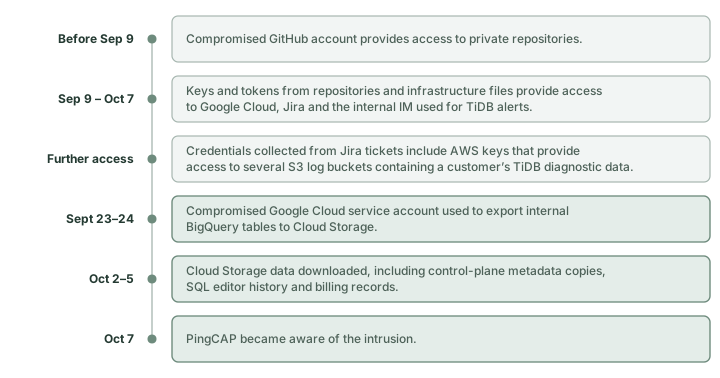
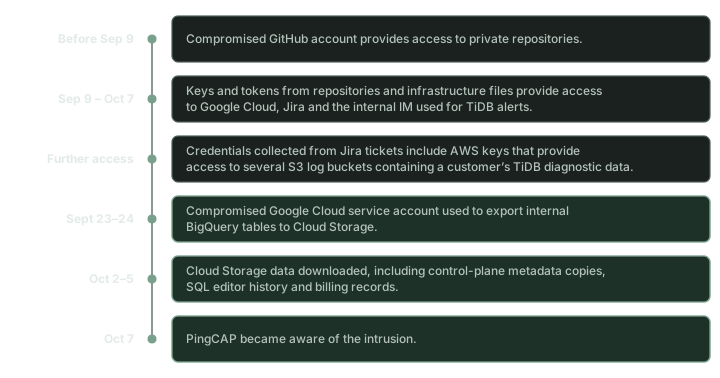
Figure 1: Credential access and data collection (UTC).
Exposed Data
NebuSec correlated cloud activity logs, the incident file inventory and reviewed data samples to identify the exposed data and sources summarized below.
| Contents | Source |
|---|---|
| Internal source code, configuration files and exposed credentials | Private GitHub repositories |
| Account and organization records, configuration of the cluster and connection, and encrypted API-key values | BigQuery and control-plane data copies in Google Cloud Storage |
| SQL editor history, AI interactions and gateway connection logs | BigQuery and service-data copies in Google Cloud Storage |
| Customer contacts, contracts, orders, revenue and billing records, and cloud resource costs | BigQuery, Google Cloud Storage |
| Usage analytics, marketing and sales records, and employee and department information | BigQuery internal analytics datasets |
| Support tickets, attachments and troubleshooting materials, including logs, SQL files and embedded credentials | Jira, AWS S3, and support data copied into BigQuery |
| Chat history and group membership lists | Enterprise IM chat history and member files |
| Infrastructure configuration and orchestration-system backups | Google Cloud Storage |
Table 1: Exposed data mapped to its source systems.
The TiDB Cloud API-key values in the exported table were encrypted, and the encryption key was not exposed. Without that key, the encrypted values could not be decrypted to recover usable API credentials.
Customer-related information was copied from PingCAP’s internal analytics, storage, and support systems. That exposure is distinct from accessing or extracting rows directly from production customer TiDB databases.
Containment and Remediation
NebuSec supported PingCAP in containing the intrusion, identifying exposed credentials and verifying remediation. The response combined access revocation with measures to keep legitimate business services running.
Credential Revocation
NebuSec confirmed PingCAP has disabled compromised service accounts, revoked exposed keys, replaced affected identities and tightened access permissions. All identified compromised credentials were invalidated and the identified unauthorized access paths were closed.
NebuSec also reviewed PingCAP’s exposed data and code repositories, scanned for additional exposed credentials, and worked with PingCAP on credential rotation and verification.
Source-Code Review and Hardening
Because the attacker obtained copies of internal source code, NebuSec conducted a focused security review of the affected services to look for flaws that an attacker with source-code access might try to exploit later. NebuSec reported four vulnerabilities with the potential to affect production data. PingCAP patched all four, and NebuSec retested each fix to verify remediation. A retrospective review of production logs found no evidence that any of these vulnerabilities had been exploited prior to being fixed.
Alongside these fixes, PingCAP expanded its logging and perimeter defenses, enabling additional Cloud Storage access logging in the affected project. PingCAP also confirmed that all 16 internet-facing services identified during the review were protected by a web application firewall (WAF). Broader credential rotation, cross-project IAM reviews and expanded secret scanning remain ongoing.
Recommended Actions
Our testing found that the TiDB Cloud API keys in the exported table are encrypted and could not be used directly. This does not apply to credentials recovered from support materials, including the AWS keys described above. We recommend that customers replace active TiDB Cloud management API keys now, following PingCAP’s published rotation guidance.
Customers who shared credentials with PingCAP support are advised to rotate them.
PingCAP is determining customer-specific impact and will contact affected customers directly. Customers should follow the published precautionary steps without waiting for individual notice.
Takeaways for Defenders
For engineering and security teams, three practices can help reduce exposure and strengthen incident response:
- Manage Credentials and Apply Least Privilege: Give service accounts, keys and tokens clear owners and only the access their workloads require. Regularly review permissions and credential lifetimes, and maintain reliable processes for rotation and revocation.
- Review Code for Vulnerabilities and Exposed Secrets: Combine security reviews with automated scanning of source code, configuration and repository history. Address both software flaws and exposed credentials, and verify remediation to reduce opportunities for further access.
- Improve Cloud Visibility: Maintain visibility into identity use, permission changes and data access across cloud services. Centralized audit records and alerts for unusual access or data movement help teams detect activity earlier and assess its scope.
Indicators of Compromise (IOCs)
The attacker used the following IP addresses to access PingCAP’s cloud environment between September 9 and October 7, 2026.
| Source IPv4 Address | Observed Dates (UTC, 2026) | Associated Activity |
|---|---|---|
146.70.173[.]219 | September 9–10 | Resource discovery across multiple compromised service accounts |
23.234.82[.]156 | September 23 | Bulk BigQuery warehouse exports (JobService.InsertJob) |
23.234.83[.]80 | September 24 | Bulk BigQuery warehouse exports (JobService.InsertJob) |
23.234.80[.]121 | September 29; October 3–5 | Resource discovery, followed by Cloud Storage downloads using rclone |
138.199.43[.]96 | October 2–3 | Cloud Storage downloads using rclone (storage.objects.get) |
23.234.81[.]225 | October 7 | Resource discovery across multiple compromised service accounts |
MITRE ATT&CK® and Artifact Mapping
The following techniques and cloud operations were observed during the investigation. Because these APIs and tools also have routine administrative uses, their investigative value comes from correlating them with anomalous source IPs, user agents, and access patterns.
| Technique | Observed Behavior and Artifacts |
|---|---|
Unsecured Credentials (T1552) | Service account private keys retained in Git commit history and plaintext Terraform state files; plaintext Jira API token and Firewatch bot key in source code or configuration. |
Valid Accounts: Cloud Accounts (T1078.004) | Direct API authentication using eight compromised Google Cloud service accounts. |
Cloud Infrastructure Discovery (T1580) | Repeated compute.instances.aggregatedList requests from external IP addresses using a Python-urllib/3.12 client signature. |
Automated Collection / Staging (T1119 / T1074.002) | Bulk BigQuery EXTRACT jobs submitted via google.cloud.bigquery.v2.JobService.InsertJob, writing 6,458 tables as .json.gz objects to Cloud Storage. |
Data from Cloud Storage (T1530) | Direct object downloads via storage.objects.get (HTTP 200 and HTTP 206) using the rclone client. |
All event times are UTC. Findings reflect the state of the investigation as of October 21, 2026. Internal resource identifiers and credential values have been omitted.
